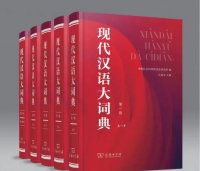
The five-volume Modern Chinese Dictionary, which has been compiled by the Institute of Linguistics of the Chinese Academy of Social Sciences for 16 years, will soon be published. This dictionary contains about 156,000 words and 12 million characters, which is different from the Modern Chinese Dictionary 现代汉语词典 in scale, nature and content, and is an original large-scale language dictionary.
In 1978, the Modern Chinese Dictionary 现代汉语词典, which was edited by the famous linguists Mr. Lu Shuxiang 吕叔湘 and Mr. Ding Shengshu 丁声树, was officially published and released. Since its publication, the Modern Chinese Dictionary has been revised seven times and its quality has been continuously improved. However, it is a medium-sized language dictionary that cannot fully satisfy the needs of readers, so it is a necessary and urgent task to compile a large and original modern Chinese dictionary. As early as the 1960s and 1970s, Mr. Lv and Mr. Ding proposed the plan of the Institute of Linguistics to compile a modern Chinese dictionary with more words and richer contents, but due to various reasons, the project was launched three times and was stopped halfway.
As a staging of the history of Chinese language, there are two different views on the beginning of modern Chinese language. The broad view is that the birth of "Dream of the Red Chamber" in the 18th century can be taken as the starting point, while the strict one is set at the period of May Fourth Movement around 1919. This dictionary adopts the latter view.
The preparatory work for the compilation of this Modern Chinese Dictionary began in the spring and summer of 2005 and was officially launched in early 2006. under the guidance of modern linguistic theory and the theory of dictionary codification, based on rich and solid literature and oral corpus, a large original language dictionary systematically recording the lexical aspects of modern Chinese for one hundred years was compiled with the Modern Chinese Dictionary 现代汉语词典 as a reference.
"The lexical system of modern Chinese should not be limited to the contemporary decades, but should also pay attention to its beginning and even the late Qing Dynasty and earlier historical stages. Based on the concept of "the history of modern Chinese", this dictionary regards the more than 100 years of modern Chinese since the May Fourth Movement as a historical period of dynamic development and change of society. This dictionary makes an effort to dynamically record and reflect the historical changes of vocabulary in the common time, breaking through the paradigm of static depiction of common time dictionaries.
*emphasis added by me

 book.douban.com
In 1978, the Modern Chinese Dictionary 现代汉语词典, which was edited by the famous linguists Mr. Lu Shuxiang 吕叔湘 and Mr. Ding Shengshu 丁声树, was officially published and released. Since its publication, the Modern Chinese Dictionary has been revised seven times and its quality has been continuously improved. However, it is a medium-sized language dictionary that cannot fully satisfy the needs of readers, so it is a necessary and urgent task to compile a large and original modern Chinese dictionary. As early as the 1960s and 1970s, Mr. Lv and Mr. Ding proposed the plan of the Institute of Linguistics to compile a modern Chinese dictionary with more words and richer contents, but due to various reasons, the project was launched three times and was stopped halfway.
As a staging of the history of Chinese language, there are two different views on the beginning of modern Chinese language. The broad view is that the birth of "Dream of the Red Chamber" in the 18th century can be taken as the starting point, while the strict one is set at the period of May Fourth Movement around 1919. This dictionary adopts the latter view.
The preparatory work for the compilation of this Modern Chinese Dictionary began in the spring and summer of 2005 and was officially launched in early 2006. under the guidance of modern linguistic theory and the theory of dictionary codification, based on rich and solid literature and oral corpus, a large original language dictionary systematically recording the lexical aspects of modern Chinese for one hundred years was compiled with the Modern Chinese Dictionary 现代汉语词典 as a reference.
"The lexical system of modern Chinese should not be limited to the contemporary decades, but should also pay attention to its beginning and even the late Qing Dynasty and earlier historical stages. Based on the concept of "the history of modern Chinese", this dictionary regards the more than 100 years of modern Chinese since the May Fourth Movement as a historical period of dynamic development and change of society. This dictionary makes an effort to dynamically record and reflect the historical changes of vocabulary in the common time, breaking through the paradigm of static depiction of common time dictionaries.
*emphasis added by me
现代汉语大词典
本词典共分五卷,收录单字字头1.3万多个(按照规范标准确定字形、字音,梳理简繁、正异、异读关系),单字和复音词语总计15.7万余条(其中百科词语约2.5万条),配例 40 多万个,全书规模达 1200...
book.douban.com