
You are using an out of date browser. It may not display this or other websites correctly.
You should upgrade or use an alternative browser.
You should upgrade or use an alternative browser.
Flashcards: Anki Emulation Mode
- Thread starter Shun
- Start date

Shun
状元
Hi,
I am having trouble trying to precisely recreate Anki's SRS behavior in Pleco. Mostly the default interval settings seem to be very different, even if I start a completely new Learning SM2 profile. The intervals are either too short or too long, with few gradations in between. Here are screenshots from Anki and Pleco. Couldn't one make it so Pleco behaves exactly like Anki does by default, in every way? (which suits me perfectly)
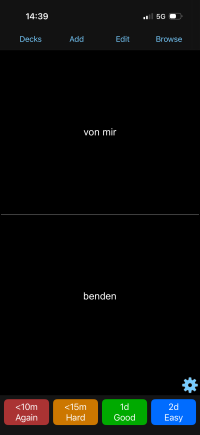
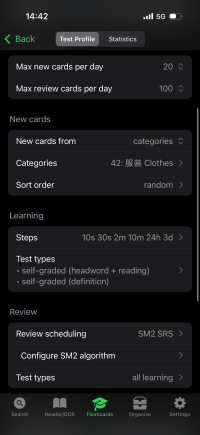
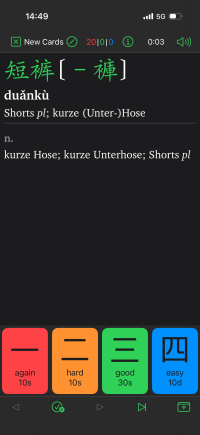
Further configurability in Pleco would be fine, just the "factory default" should be the same.
Thanks,
Shun
I am having trouble trying to precisely recreate Anki's SRS behavior in Pleco. Mostly the default interval settings seem to be very different, even if I start a completely new Learning SM2 profile. The intervals are either too short or too long, with few gradations in between. Here are screenshots from Anki and Pleco. Couldn't one make it so Pleco behaves exactly like Anki does by default, in every way? (which suits me perfectly)
Further configurability in Pleco would be fine, just the "factory default" should be the same.
Thanks,
Shun

I would be reluctant to make the Anki defaults the defaults in Pleco because they're not really equivalent; a single Pleco card equals multiple Anki cards, i.e., if you add a new bidirectional card in Anki you would have overlapping reviews of it in both directions. We think our approach is generally more logical for language vocabulary in a dictionary app, but it does make it hard to square with Anki's math.
Anyway, if you configure the learning steps to match those in your Anki deck settings, and go into 'configure SM2 algorithm' / turn off 'set intervals automatically' / manually set them to whatever those are in Anki, that should match up with the default Anki settings. I just now tried creating a new card with stock settings in the Anki desktop app and did not see the same intervals you have on your screen - some decks come with different ones, if you send me a backup of this Anki deck I can figure out what it's using and how to match that in Pleco. There may also be some version mismatches, I think there's a feature now where the 'hard' interval is the average of two others which wasn't there at the time we wrote our Anki emulator?
I suppose we could look at adding an option to configure it with Anki's default settings, but the practical effect of that would be that unless you were studying in just one direction, you would end up seeing a card too infrequently.
Anyway, if you configure the learning steps to match those in your Anki deck settings, and go into 'configure SM2 algorithm' / turn off 'set intervals automatically' / manually set them to whatever those are in Anki, that should match up with the default Anki settings. I just now tried creating a new card with stock settings in the Anki desktop app and did not see the same intervals you have on your screen - some decks come with different ones, if you send me a backup of this Anki deck I can figure out what it's using and how to match that in Pleco. There may also be some version mismatches, I think there's a feature now where the 'hard' interval is the average of two others which wasn't there at the time we wrote our Anki emulator?
I suppose we could look at adding an option to configure it with Anki's default settings, but the practical effect of that would be that unless you were studying in just one direction, you would end up seeing a card too infrequently.
Shun
状元
Thanks for the detailed replies. Most of my Anki cards are indeed bidirectional, so two cards per note, while some are unidirectional, where two directions don't make sense. I believe that Anki treats every card separately as a card, without looking at any relationships between cards. I like that. This may create the strange situation you mention where one is tested in both directions close together in the beginning, but once one is able to answer one more easily than the other, the cards will be spaced far enough apart from each other for all later tests, making that effect go away.
I'm sure you're making a maximum effort to match Pleco's behavior to Anki's. As I'm not familiar enough with the technical differences, may I ask if Pleco 4 supports stacks of cards like Anki, or does it still calculate which card should be next based on scores, selected intervals and other metadata?
I can also wait for the Pleco 4 documentation to come out, so you don't need to write too much here.
Shun
I'm sure you're making a maximum effort to match Pleco's behavior to Anki's. As I'm not familiar enough with the technical differences, may I ask if Pleco 4 supports stacks of cards like Anki, or does it still calculate which card should be next based on scores, selected intervals and other metadata?
I can also wait for the Pleco 4 documentation to come out, so you don't need to write too much here.
Shun
Sorry, what do you mean by 'stacks of cards'?
We have an implementation of Anki's separate-card-for-each-side thing - essentially we create a hidden test profile for each side index - but we haven't yet decided whether to ship it, and most likely won't in the initial version. I don't love it because it among other things it effectively locks your score data to a specific set of test types - less of a problem in Anki where there's basically just self-graded cards and a half-hearted fill-in-the-blanks feature, but in Pleco you might want to, say, add a multi-choice definition test into the mix for your existing review cards, and the only way you could do that in an Anki-style system is to a) switch one of your existing sides (say, definition hidden self-graded) to that or b) start a brand new one or maybe c) duplicate scores from the nearest equivalent to your new side (though I'm not sure if Anki actually lets you do that).
The larger philosophical question is how much we really want to exactly emulate Anki, when people who like Anki are probably going to keep using Anki because we're never going to be able 100% satisfy them as far as matching up with Anki perfectly (even if we briefly did, Anki would release an update changing some other little thing and then we'd have a new batch of complaints), versus how much we want to let people who are Pleco-curious bring their Anki cards into Pleco, preserve some of the basic things - like again/hard/good/easy scoring - they were accustomed to in Anki, but otherwise have them moved onto our system with its various advantages and disadvantages.
We have an implementation of Anki's separate-card-for-each-side thing - essentially we create a hidden test profile for each side index - but we haven't yet decided whether to ship it, and most likely won't in the initial version. I don't love it because it among other things it effectively locks your score data to a specific set of test types - less of a problem in Anki where there's basically just self-graded cards and a half-hearted fill-in-the-blanks feature, but in Pleco you might want to, say, add a multi-choice definition test into the mix for your existing review cards, and the only way you could do that in an Anki-style system is to a) switch one of your existing sides (say, definition hidden self-graded) to that or b) start a brand new one or maybe c) duplicate scores from the nearest equivalent to your new side (though I'm not sure if Anki actually lets you do that).
The larger philosophical question is how much we really want to exactly emulate Anki, when people who like Anki are probably going to keep using Anki because we're never going to be able 100% satisfy them as far as matching up with Anki perfectly (even if we briefly did, Anki would release an update changing some other little thing and then we'd have a new batch of complaints), versus how much we want to let people who are Pleco-curious bring their Anki cards into Pleco, preserve some of the basic things - like again/hard/good/easy scoring - they were accustomed to in Anki, but otherwise have them moved onto our system with its various advantages and disadvantages.
Shun
状元
Yes, maybe you already have a stack of cards: A stack that stays the same like a physical deck, that you can only add cards to in a place of your/the app's choosing, but that will not change dynamically apart from that.
I would already be happy if Anki's basic mode of functioning with simple bidirectional Self-graded cards were exactly replicated, no other bells and whistles. That should be plenty for most, and users should understand that that is the farthest you can go.
Can you perhaps, just for completeness, confirm whether that should already be Pleco 4's current behavior if I make the settings you suggested I make at the beginning?
I would already be happy if Anki's basic mode of functioning with simple bidirectional Self-graded cards were exactly replicated, no other bells and whistles.
That should be plenty for most, and users should understand that that is the farthest you can go.Can you perhaps, just for completeness, confirm whether that should already be Pleco 4's current behavior if I make the settings you suggested I make at the beginning?
I'm still not 100% sure if I'm getting it but couldn't you have a 'stack' by simply reviewing a category in category order?
At the moment the only way to get the exact bidirectional behavior you're talking about would be to create a different profile for each direction. We could support that within a single profile and nested sub-profiles, and as I said we already have an implementation of that, but it's something we're probably going to have to wait on more feedback before we go live with.
The current Pleco would behave a little differently due to the bug I mentioned and the lack of that 'hard' behavior (which seems easy to add, actually) but should be similar otherwise.
At the moment the only way to get the exact bidirectional behavior you're talking about would be to create a different profile for each direction. We could support that within a single profile and nested sub-profiles, and as I said we already have an implementation of that, but it's something we're probably going to have to wait on more feedback before we go live with.
The current Pleco would behave a little differently due to the bug I mentioned and the lack of that 'hard' behavior (which seems easy to add, actually) but should be similar otherwise.
Shun
状元
I'm still not 100% sure if I'm getting it but couldn't you have a 'stack' by simply reviewing a category in category order?
Almost: As far as I can tell, Anki orders the cards randomly at the beginning but then keeps them like in category order.
At the moment the only way to get the exact bidirectional behavior you're talking about would be to create a different profile for each direction. We could support that within a single profile and nested sub-profiles, and as I said we already have an implementation of that, but it's something we're probably going to have to wait on more feedback before we go live with.
All right.
The current Pleco would behave a little differently due to the bug I mentioned and the lack of that 'hard' behavior (which seems easy to add, actually) but should be similar otherwise.
Thank you! That would indeed be great, and if it's easy to implement, perhaps that is the one wish with a good cost-benefit ratio, that would be another large step toward mimicking Anki-ness.
Shun
It wouldn't be hard to add a 'randomize order' command for categories if there's interest, though I'm not really sure why you would want the same random order each time - isn't that likely to make the memory of some cards dependent on others?Almost: As far as I can tell, Anki orders the cards randomly at the beginning but then keeps them like in category order.
Shun
状元
Hmm, isn't the order of the cards somehow saved in the current profile while learning is ongoing, leaving the flashcard category order untouched? That said, it may also be nice if a study session changed the category order according to user selections of how well they have remembered their cards.
The advantage of that would be that all the spacings would remain as they were between sessions. (cards you know well would be far towards the back of the stack, and cards you don't know well would be closer to the top)
I've never thought of the effect of keeping cards in the same order affecting memorization; but that doesn't really apply here, as I think there is enough shuffling of cards because cards you know well would jump back a lot farther in the stack.
Would that perhaps be a nice solution?
The advantage of that would be that all the spacings would remain as they were between sessions. (cards you know well would be far towards the back of the stack, and cards you don't know well would be closer to the top)
I've never thought of the effect of keeping cards in the same order affecting memorization; but that doesn't really apply here, as I think there is enough shuffling of cards because cards you know well would jump back a lot farther in the stack.
Would that perhaps be a nice solution?
Last edited:
It actually draws them randomly as you go along, there's no set order of pending cards in the session. You can configure cards to display in a category sorted by their % correct or # correct.Hmm, isn't the order of the cards somehow saved in the current profile while learning is ongoing, leaving the flashcard category order untouched? That said, it may also be nice if a study session changed the category order according to user selections of how well they have remembered their cards.
You can use those same kinds of sort orders in a 'simple' profile (which kind of has a lot of the functionality people do in custom tests in Anki).The advantage of that would be that all the spacings would remain as they were between sessions. (cards you know well would be far towards the back of the stack, and cards you don't know well would be closer to the top)