
You are using an out of date browser. It may not display this or other websites correctly.
You should upgrade or use an alternative browser.
You should upgrade or use an alternative browser.
Outlier Dictionary of Chinese Characters
- Thread starter mikelove
- Start date

alex_hk90
状元
Firstly, thanks to all involved for the new update - some very interesting new Expert entries. 
One thing I noticed is that some of the rarer characters are not showing up for me (on Android) - do I need to change/install a different font that includes them?
Screenshot using the example entry from the latest blog update:
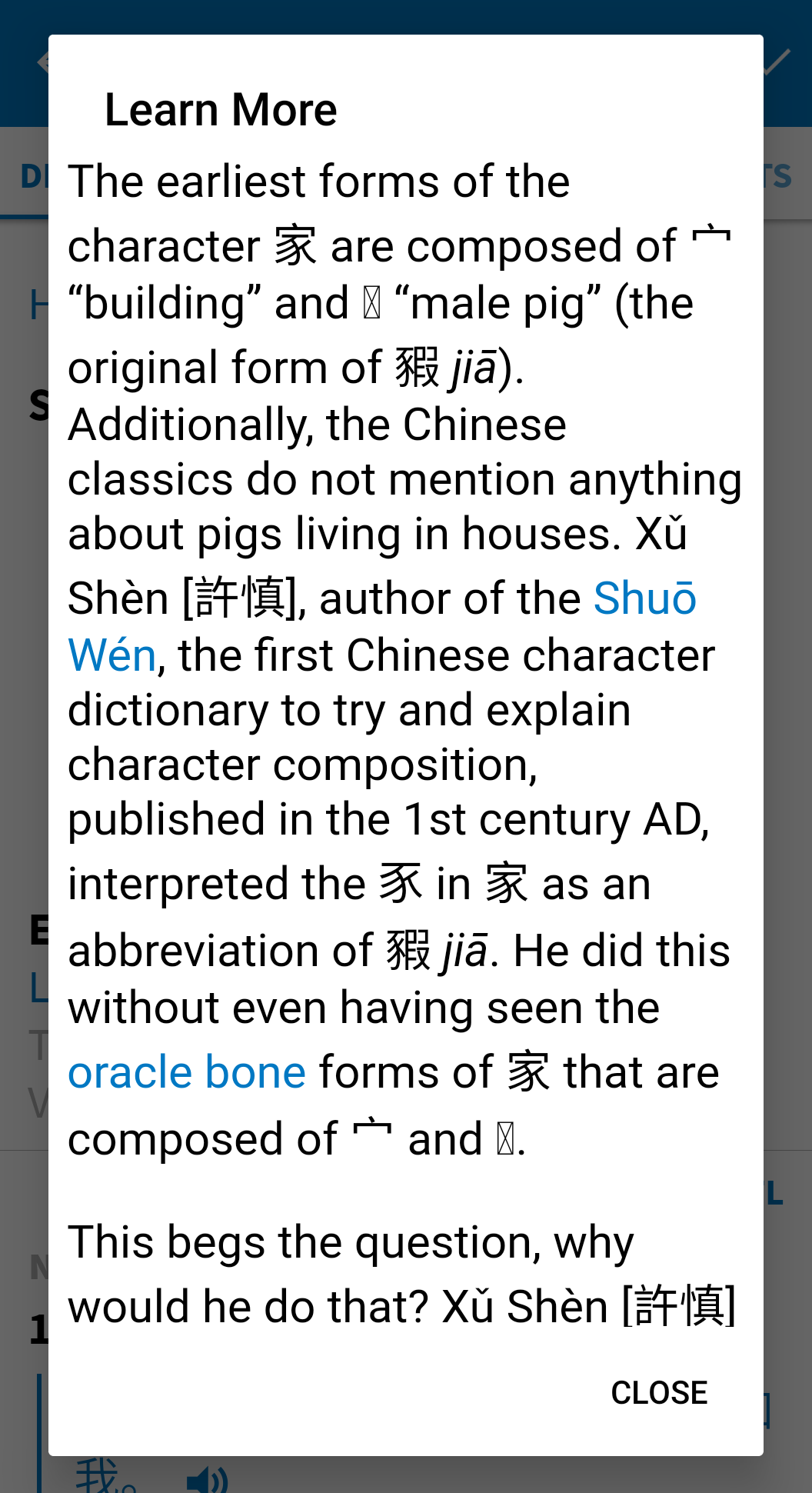
One thing I noticed is that some of the rarer characters are not showing up for me (on Android) - do I need to change/install a different font that includes them?
Screenshot using the example entry from the latest blog update:

JD
状元
@Ash: any chance you could share the changelog for the latest update? I’d like to see which entries have been updated. Thanks.
The Outlier email to Kickstarter supporters lists these entries specifically for the Expert edition
============
We've just released another 55 Expert entries for those of you who have the Expert Edition. We also updated a few of the Essentials entries and added a few. There will be more new Essentials entries in the next update.
You should get the update automatically in Pleco. If not, you can go to Menu > Add-ons > Updated and update your copy there.
Here are the 55 new entries:
Traditional: 丁七戈國個戌成耒或甘舟木个田甲十穆么行子豕番六女幺西要和于疒經力採肩新家方禾心必釆采介城角域巠信矢古審壬曰固盾
Simplified: 丁七戈國戌成耒或甘舟木个田甲十穆么行子豕番六女幺西要和于疒力审肩新家方禾心必釆采介城经角域信矢古壬曰固国盾
There's some really interesting stuff in there, so be sure to check them out if you have the Expert Edition!
Last edited:
goldyn chyld
状元
Works fine on iOS tho.Firstly, thanks to all involved for the new update - some very interesting new Expert entries.
One thing I noticed is that some of the rarer characters are not showing up for me (on Android) - do I need to change/install a different font that includes them?
Screenshot using the example entry from the latest blog update:
View attachment 3458
goldyn chyld
状元
Thanks for posting this. It would be useful if they posted such info on their blog as well for others to see...The Outlier email to Kickstarter supporters lists these entries specifically for the Expert edition
============
We've just released another 55 Expert entries for those of you who have the Expert Edition. We also updated a few of the Essentials entries and added a few. There will be more new Essentials entries in the next update.
You should get the update automatically in Pleco. If not, you can go to Menu > Add-ons > Updated and update your copy there.
Here are the 55 new entries:
Traditional: 丁七戈國個戌成耒或甘舟木个田甲十穆么行子豕番六女幺西要和于疒經力採肩新家方禾心必釆采介城角域巠信矢古審壬曰固盾
Simplified: 丁七戈國戌成耒或甘舟木个田甲十穆么行子豕番六女幺西要和于疒力审肩新家方禾心必釆采介城经角域信矢古壬曰固国盾
There's some really interesting stuff in there, so be sure to check them out if you have the Expert Edition!

羊肉泡馍
Member
Thanks for posting this. It would be useful if they posted such info on their blog as well for others to see...
Yes, at this point it is like finding a needle in a haystack. Hopefully those promised monthly updates will be here soon. Starting to wonder what is going on or if there will ever be more than a few hundred entries. Hopefully, I will proved wrong next month.

I was looking forward to this. Thank you, John, and Outlier Linguistics!
System-level character info + Pronunciation Course finished!
System-level Info
This is something we've been working on for a while—we actually talked about it during the Kickstarter campaign, and it's included in the demo. It will be a massive upgrade to the dictionary. We're adding a ton of data to the dictionary that we're calling the "System-level Info." For every component or character that shows up as a component in other characters, you'll be able to tap a link in the dictionary that will pull up a list of all the characters it shows up in, separated by function. So you'll be able to see all the characters it appears in as a sound component, as a semantic component, as an empty component, and as a radical.
This makes the system-level connections between characters and components super clear and obvious. You can see at a glance what different pronunciations can be represented by a sound component, for example, and how the component meaning relates to the meaning of character it appears in as a semantic component. It also makes it really clear that a character's "radical" isn't always a semantic component. Just take a look at 甥 in the example entry below—its radical is 生, but 生 is a sound component in 甥, not a semantic component.
Again, these entries will be available for any character or component that shows up as a component in other characters, so there will be 1321 system-level entries! We're getting close to being able to release it—just a few things to finish up first.
Here's the system entry for 生 so you can get an idea of what it will be like (of course the formatting in the dictionary itself will be much nicer than this plain text):
---------------------
System level info for component 生
Sound series (6 members)
This is the sound series for 生 shēng.
* 性 xìng: nature; character; sex
* 星 xīng: a star, planet; any point of light
* 姓 xìng: one's family name; clan, people
* 牲 shēng: sacrificial animal; animal
* 甥 shēng: sister's child
* 笙 shēng: small gourd-shaped musical instrument
Semantic series (2 members)
This is the semantic series for 生.
Meaning tree for the component:
1. (orig.) to grow, to emerge
* 產 chǎn: [(orig.) to grow]; give birth, bring forth, produce
* 姓 xìng: [(orig.) sign of belonging to a clan (i.e., a clan name)]; one's family name; clan, people
As empty component (no members)
生 does not generally appear as an empty component.
Radical
This is KangXi radical 100. Radical list (2 members):
產 chǎn: give birth, bring forth, produce
甥 shēng: sister's child
System-level character info + Pronunciation Course finished!
System-level Info
This is something we've been working on for a while—we actually talked about it during the Kickstarter campaign, and it's included in the demo. It will be a massive upgrade to the dictionary. We're adding a ton of data to the dictionary that we're calling the "System-level Info." For every component or character that shows up as a component in other characters, you'll be able to tap a link in the dictionary that will pull up a list of all the characters it shows up in, separated by function. So you'll be able to see all the characters it appears in as a sound component, as a semantic component, as an empty component, and as a radical.
This makes the system-level connections between characters and components super clear and obvious. You can see at a glance what different pronunciations can be represented by a sound component, for example, and how the component meaning relates to the meaning of character it appears in as a semantic component. It also makes it really clear that a character's "radical" isn't always a semantic component. Just take a look at 甥 in the example entry below—its radical is 生, but 生 is a sound component in 甥, not a semantic component.
Again, these entries will be available for any character or component that shows up as a component in other characters, so there will be 1321 system-level entries! We're getting close to being able to release it—just a few things to finish up first.
Here's the system entry for 生 so you can get an idea of what it will be like (of course the formatting in the dictionary itself will be much nicer than this plain text):
---------------------
System level info for component 生
Sound series (6 members)
This is the sound series for 生 shēng.
* 性 xìng: nature; character; sex
* 星 xīng: a star, planet; any point of light
* 姓 xìng: one's family name; clan, people
* 牲 shēng: sacrificial animal; animal
* 甥 shēng: sister's child
* 笙 shēng: small gourd-shaped musical instrument
Semantic series (2 members)
This is the semantic series for 生.
Meaning tree for the component:
1. (orig.) to grow, to emerge
* 產 chǎn: [(orig.) to grow]; give birth, bring forth, produce
* 姓 xìng: [(orig.) sign of belonging to a clan (i.e., a clan name)]; one's family name; clan, people
As empty component (no members)
生 does not generally appear as an empty component.
Radical
This is KangXi radical 100. Radical list (2 members):
產 chǎn: give birth, bring forth, produce
甥 shēng: sister's child
Hi Pleco Team,
I enjoy this dictionary. But lately, I have been using the meaning part pretty often, and it is located at the bottom of the dictionary definition. Therefore, is it possible to arrange the meaning part into the first part?
or maybe more generalized question are:
- is it possible to arrange the dictionary partition?
- or maybe hidden one / some of the parts?
I enjoy this dictionary. But lately, I have been using the meaning part pretty often, and it is located at the bottom of the dictionary definition. Therefore, is it possible to arrange the meaning part into the first part?
or maybe more generalized question are:
- is it possible to arrange the dictionary partition?
- or maybe hidden one / some of the parts?
Attachments
goldyn chyld
状元
Any word on when the next update is coming? It’s been like 5 months or so.

Any word on when the next update is coming? It’s been like 5 months or so.
My impression from them is that it's getting close but I can't offer anything more concrete than that.

John Renfroe
进士
Hi all,
We just released a huge update to our dictionary.
This update is included in both the Essentials and Expert Editions of the dictionary (but not Mini).
The "System-level Info" adds a ton of useful information about how Chinese characters work on the system level. This makes the sound and meaning connections between characters super clear.
For any component, or character that acts as a component in other characters, you can see all the characters it shows up in, broken down by function.
For example, you can see every character containing 生, whether it's a sound component, semantic component, or empty component.
We also show you every character it shows up in as a radical—you'll see very clearly that "radicals" and "semantic components" are NOT the same thing. For example:
So 生 is the radical for 甥, but it isn't a semantic component—it's a sound component in 甥.
Note that the semantic series have the original meanings in red text, since the focus is on meaning. The sound series (below) have the pronunciations in red. This makes it really easy to see all the important information at a glance.
You'll also see the range of pronunciations a sound component can give. For example, the following characters contain 生 as a sound component:
Check out this video for more info:
If you don't have the dictionary yet, you can get it here: https://www.outlier-linguistics.com/products/outlier-dictionary-of-chinese-characters
Use the discount code 'systemdata' at checkout for 20% off the dictionary and/or anything else in the store.
We just released a huge update to our dictionary.
This update is included in both the Essentials and Expert Editions of the dictionary (but not Mini).
The "System-level Info" adds a ton of useful information about how Chinese characters work on the system level. This makes the sound and meaning connections between characters super clear.
For any component, or character that acts as a component in other characters, you can see all the characters it shows up in, broken down by function.
For example, you can see every character containing 生, whether it's a sound component, semantic component, or empty component.
We also show you every character it shows up in as a radical—you'll see very clearly that "radicals" and "semantic components" are NOT the same thing. For example:
This is the semantic series for 生.
Meaning tree for the component:
(orig.) to grow, to emerge
[...]
- 產 chǎn: [(orig.) to grow]; give birth, bring forth, produce
- 姓 xìng: [(orig.) sign of belonging to a clan (i.e., a clan name)]; one's family name; clan, people
This is KangXi radical 100. Radical list (2 members):
- 產 chǎn: give birth, bring forth, produce
- 甥 shēng: sister's child
So 生 is the radical for 甥, but it isn't a semantic component—it's a sound component in 甥.
Note that the semantic series have the original meanings in red text, since the focus is on meaning. The sound series (below) have the pronunciations in red. This makes it really easy to see all the important information at a glance.
You'll also see the range of pronunciations a sound component can give. For example, the following characters contain 生 as a sound component:
This is the sound series for 生 shēng.
- 性 xìng: nature, character; sex
- 星 xīng: a star, planet; any point of light
- 姓 xìng: one's family name; clan, people
- 牲 shēng: sacrificial animal; animal
- 甥 shēng: sister's child
- 笙 shēng: small gourd-shaped musical instrument
This is the sound series for 各 gè.
路 lù: road, path, street; journey
略 lüè: approximately, roughly; outline
洛 luò: river in Shanxi province; city
駱 luò: a white horse with black mane; a camel
烙 lào (luò): brand, burn; branding iron
酪 lào (luò): cream, cheese; koumiss
絡 luò (lào): enmesh, wrap around; web, net
賂 lù: bribe; give present
格 gé: pattern, standard, form; style
胳 gē: armpit, arms
骼 gé: bone; skeleton; corpse
閣 gé: chamber, pavilion; cabinet
客 kè: guest, traveller; customer
咎 jiù (gāo): fault, defect; error, mistake
Check out this video for more info:
If you don't have the dictionary yet, you can get it here: https://www.outlier-linguistics.com/products/outlier-dictionary-of-chinese-characters
Use the discount code 'systemdata' at checkout for 20% off the dictionary and/or anything else in the store.

Ash
进士
As you can see, we've been working on getting the system data out. We are also working on the next Essentials/Expert release, which will have around 350 Essentials entries and 50-ish Expert entries. I would guestimate that it will be released in 6 to 8 weeks.Any word on when the next update is coming? It’s been like 5 months or so.
I don't know but something about Outlier rubs me the wrong way. There is seemingly a lot of work put into the sales pitch, including the "webinar" on the website that is conveniently always just about to start which is just a basic lesson + sales pitch complete with a fake chat ("wow, this is great" "I love your product"). I'd much prefer seeing put more work into the actual product which I still find underwhelming compared to already existing ressources.
Ash
进士
Well, we can't possibly please everyone.I don't know but something about Outlier rubs me the wrong way. There is seemingly a lot of work put into the sales pitch, including the "webinar" on the website that is conveniently always just about to start which is just a basic lesson + sales pitch complete with a fake chat ("wow, this is great" "I love your product"). I'd much prefer seeing put more work into the actual product which I still find underwhelming compared to already existing ressources.
Especially someone that complains about time spent on product development, while simultaneously complaining about the pre-recorded webinar (which saves us a lot of time, i.e., more time for product development) and seems to suggest doing live webinars (which take up a lot of time, i.e., less time for product development). The webinar tells you in the beginning that it's not live. Not sure how that's an issue.
However, I do need to correct you on one thing, for the benefit of others who may see this comment. The comments aren't fake. They're all real comments from previous webinar attendees.
Sorry to disappoint!
JD
状元
@Ferran
To me, the Outlier dictionary has been one of the most valuable dictionary resources I have on Pleco. Maybe I'm biased (and I did help fund Outlier via Kickstarter when it began) but I find the SCHOLARLY historical research and "lineage" of the characters add a lot of value to my Chinese study.
If somebody is looking for merely a definition, then Outlier isn't going to be much value for that. Outlier gives "subtlety" to the history and etymology of words, and many people don't want or need to know that.
Edit: Via their historical research, they are also publishing CORRECT information based on the latest data, rather than regurgitating known historical inaccuracies that other dictionaries use. To me, this "refresh" of the record is quite valuable!
The basic Outlier dictionary costs $30. If you don't find value there, don't buy it. I've definitely gotten more value out of my Outlier content than I have out of my $20 Chengyu dictionary purchase, my $20 Proverb dictionary, or the several $10 voice packages, or the myriad other dictionaries I use maybe once or twice a month.
As far as advertising, I get more annoyed by seeing a CocaCola ad pop up via "product placement" in the middle of a movie than I would by going to a site FOR a product, and having them offer mini-commercials for their own products on their own site.
To me, the Outlier dictionary has been one of the most valuable dictionary resources I have on Pleco. Maybe I'm biased (and I did help fund Outlier via Kickstarter when it began) but I find the SCHOLARLY historical research and "lineage" of the characters add a lot of value to my Chinese study.
If somebody is looking for merely a definition, then Outlier isn't going to be much value for that. Outlier gives "subtlety" to the history and etymology of words, and many people don't want or need to know that.
Edit: Via their historical research, they are also publishing CORRECT information based on the latest data, rather than regurgitating known historical inaccuracies that other dictionaries use. To me, this "refresh" of the record is quite valuable!
The basic Outlier dictionary costs $30. If you don't find value there, don't buy it. I've definitely gotten more value out of my Outlier content than I have out of my $20 Chengyu dictionary purchase, my $20 Proverb dictionary, or the several $10 voice packages, or the myriad other dictionaries I use maybe once or twice a month.
As far as advertising, I get more annoyed by seeing a CocaCola ad pop up via "product placement" in the middle of a movie than I would by going to a site FOR a product, and having them offer mini-commercials for their own products on their own site.
I don't understand the pricing of the Outlier dictionary. I seem to have Expert and Essentials. The latest upgrade to Essentials would cost me $19.99. Is that correct? Just asking. I had assumed that buying the dictionary would include the upgrade. Not complaining, I just don't find it clear.