Wrong tone colour for characters after slashes

eliaspays

Member
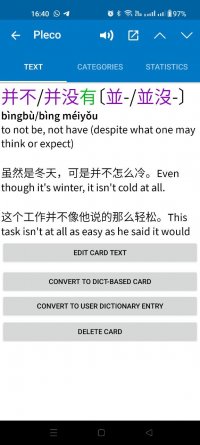
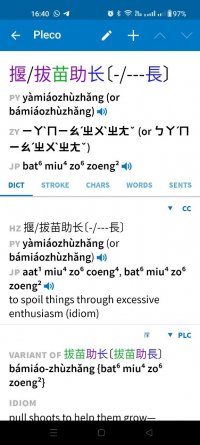
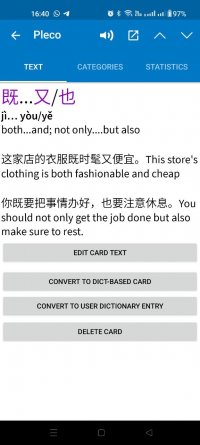
When two characters are separated by slashes as alternatives, the character behind the slash will always have the same 'tone colour' as the one before the slash, even if the tone is different. This applies both to user-created flashcards and to existing dictionary entries, as the images show.

(I think there may be something weird happening with the colour being 'pushed ahead' one character, as in the example with 并没有 where 有 is the colour 没 should be).

Is there any way to fix this?
 

Attachments

  • photo_2026-01-30_16-44-02.jpg
    photo_2026-01-30_16-44-02.jpg
    77 KB · Views: 15
  • photo_2026-01-30_16-44-01.jpg
    photo_2026-01-30_16-44-01.jpg
    83.7 KB · Views: 11
  • photo_2026-01-30_16-43-59.jpg
    photo_2026-01-30_16-43-59.jpg
    98 KB · Views: 11

mikelove

皇帝
Staff member
The way /s work in Pleco is that we assume that the two /-separated characters have the same pronunciation and the / is basically telling the tone coloring system to repeat the last tone, so it actually looks like this is all working like it's supposed to; there isn't / support for pinyin, we simply ignore /s in that, so your first entry looks to Pleco like you have an expression with pinyin "ji4 you4" where the 2nd character pronounced "you4" can be either a 又 or a 也.

For your first two images, if you use some other character to split your headword variations - | for example - it should match them up with pinyin correctly, since it will now understand that each character has a unique pinyin syllable associated with it. (you can keep using a / in pinyin, it doesn't matter, it's only in characters where it's producing the wrong behavior)

For the third image, it's not applying the pinyin from the parenthetical to the alternate character but it looks like it's tracking the syllables correctly - Miao is 2nd, Zhu is 4th, Zhang is 3rd. In our next major update we are no longer displaying entries that vary in both their characters and pinyin as a single entry, since it can get very confusing like this; instead we show the word you searched for on top and list the other version in a 'variants' section at the bottom.
 

eliaspays

Member
Thank you for the answer and the explanation! I tried switching to | instead but now it shows no tone at all for 也 (since there are four characters but only 3 pinying entries I suppose). Would there be any way to show the tone for 也 without showing any pinyin for | ?
 

mikelove

皇帝
Staff member
What kind of | was it? It should be skipping the | but maybe it was a full-width one and it recognized that as a Chinese character - if you type a | with a regular English keyboard it should hopefully be one that it won't treat as a character.
 
Top